Courses Taught
-
University of Chicago
PHIL23207/32307
(Spring 2026, 27)
This course introduces students to key concepts, texts, and figures from the phenomenological tradition as it emerged and developed in Germany and France over the 19th and 20th centuries. Students will engage with questions of intentionality, temporality, embodiment, finitude, and meaning-making. The course will pay particular attention to continuities and discontinuities between key figures. Major authors covered include: Franz Brentano, Edmund Husserl, Edith Stein, Martin Heidegger, Hans-Georg Gadamer, Maurice Merleau-Ponty, Simone de Beauvoir, Jean-Paul Sartre, Albert Camus, and Samuel Beckett.
-
University of Chicago
HUMA11500
(Autumn 2023, 24, 25, 26)
In the Philosophical Perspectives sequence students encounter perennial questions, arguments, and themes in Western philosophy and literature, all while building familiarity with analytical, comparative, historical, and philosophical scholarly practices. The Autumn course is dedicated to Ancient Greek and early Roman perspectives on the good life, human nature, virtue, death, knowledge, politics, and making sense of suffering. We will approach philosophical texts by Sophocles, Plato, Aristotle, and Boethius as historically situated artifacts that shaped (and were shaped by) the intellectual horizons of Greece and Rome, and that invite us to participate in a distinctive practice of questioning, wondering, and thinking with others. Through close textual and comparative analyses (both in conversation and in writing), students will build familiarity with the scholarly practices and methods associated with the study of the history of philosophy.
Authors include Sophocles (Oedipus Tyrannus), Plato (Euthyphro, Meno, Apology, Republic), Aristotle (Nicomachean Ethics), and Boethius (Consolation of Philosophy).
-
University of Chicago
HUMA11600
(Winter 2024, 25)
In the Philosophical Perspectives sequence students encounter perennial questions, arguments, and themes in Western philosophy and literature, all while building familiarity with analytical, comparative, historical, and philosophical scholarly practices. The Winter quarter is dedicated to Early Modern perspectives on epistemology, perception, causality, and the limits of reason. What can we really know about the world around us, or the self? How can we safeguard ourselves from delusion? How reliable is human reason? Students will build upon the scholarly practices and habits of mind introduced in the Autumn quarter to perform close textual and comparative analyses (both in conversation and in writing), and thoroughly rehearse key arguments that radically shifted the direction of the Western philosophical tradition.
Authors include Michel de Montaigne, Teresa of Ávila, Miguel de Cervantes, René Descartes, Elisabeth of Bohemia, David Hume.
-
University of Chicago
HUMA11700
(Spring 2024, 25, 26)
In the Philosophical Perspectives sequence students encounter perennial questions, arguments, and themes in Western philosophy and literature, all while building familiarity with analytical, comparative, historical, and philosophical scholarly practices. The Spring quarter is dedicated to classical and contemporary perspectives on ethics from the 18th century forward. Students will navigate complex philosophical questions of normativity, responsibility, culpability, and justice.
Authors include David Hume, Immanuel Kant, John Stuart Mill, James Joyce, Hannah Arendt, Bernard Williams, Charlotte Perkins Gilman, Miranda Fricker, Michele Moody-Adams, Iris Young.
-
Tufts University
EXP014
(Spring 2023)
How do emotions fit into the realm of politics? This course draws from a wide range of resources from the history of philosophy, political theory, and moral psychology in order to critically analyze and reimagine the traditional role(s) of emotion in politics. Historically, emotions and passions have been both maligned as irrational distractions that should be excluded from civil deliberation about justice, and championed as essential ingredients for social cohesion and ‘fellow feeling.’ Our course considers a diversity of historical and contemporary perspectives on the ways in which emotions are inextricably woven into the fabric of our identities, moral judgments, communication, and political responsibilities. We will explore, for example, emotions that inform us about our values, priorities, and place in the world; emotions that contribute to in-group solidarity, providing a basis for collective social change; and more nefarious affects such as fear and disgust that can be manipulated for political ends. Some key topics addressed in the course will be: collective guilt, anger, shame, patriotism, regret, wonder, forgiveness, fear, tone-policing, and divestment.
-
Tufts University
EXP004
(Fall 2020)
What are the unspoken ethical codes that influence the way we respond to ignorance? Despite its negative associations, all human experience involves ignorance. Some ignorance is unavoidable given the limitations of our intelligence and technology. At other times, ignorance plays a vital civic function - for example, ignorance of others' passwords and personal financial information provides essential security. But there are also forms of ignorance that are inherently harmful. Racism, sexism, and other expressions of identity-based discrimination can follow directly from specific forms of ignorance, and they compel us to respond ethically. Using a variety of texts, films, and other materials dealing with philosophy, politics, history, literature, gender, and race, this course will take an interdisciplinary and multi-media approach to clarifying what ignorance is and how we ought to respond to it.
-
Boston College
PHIL 5527
(Spring 2020)
This course explores key debates in 20th-century Philosophy of Language in both the Anglo-American and Continental philosophical traditions. Special attention will be paid to ‘crossover’ moments between these two traditions. Key figures covered include Bertrand Russell, Ludwig Wittgenstein, J. L. Austin, Jacques Derrida, Paul Ricœur, W. V. Quine, Donald Davidson, and Richard Rorty.
-
Boston College
(Fall 2018, 19, 20)
This course will introduce students to key works in the canon of Western philosophy from the Ancient and Medieval periods. We will focus our attention on epistemological and ethical concerns that arise in these texts as they relate to broad issues of personhood, justice, happiness, virtue, and truth. Students will learn to read, write, and speak philosophically by engaging with multiple authors simultaneously and drawing connections across the history of philosophy. This course satisfies half of the Core Philosophy Requirement. Key figures covered include Plato, Aristotle, Augustine, Boethius, and Aquinas.
-
Boston College
PHIL1071
(Spring 2019, 20, 21, 22)
This course will introduce students to key texts in the canon of Western philosophy from the 17th-century to the 20th-century. We will focus our attention on epistemological and ethical concerns that arise in these texts as they relate to broad issues of personhood, justice, happiness, and language. Students will learn to read, write, and speak philosophically, which means they will engage with multiple authors simultaneously in order to draw connections across the history of philosophy. This course satisfies half of the Core Philosophy Requirement. Key figures covered include René Descartes, David Hume, Immanuel Kant, Søren Kierkegaard, Hannah Arendt, Linda Martín Alcoff, Charles Mills.
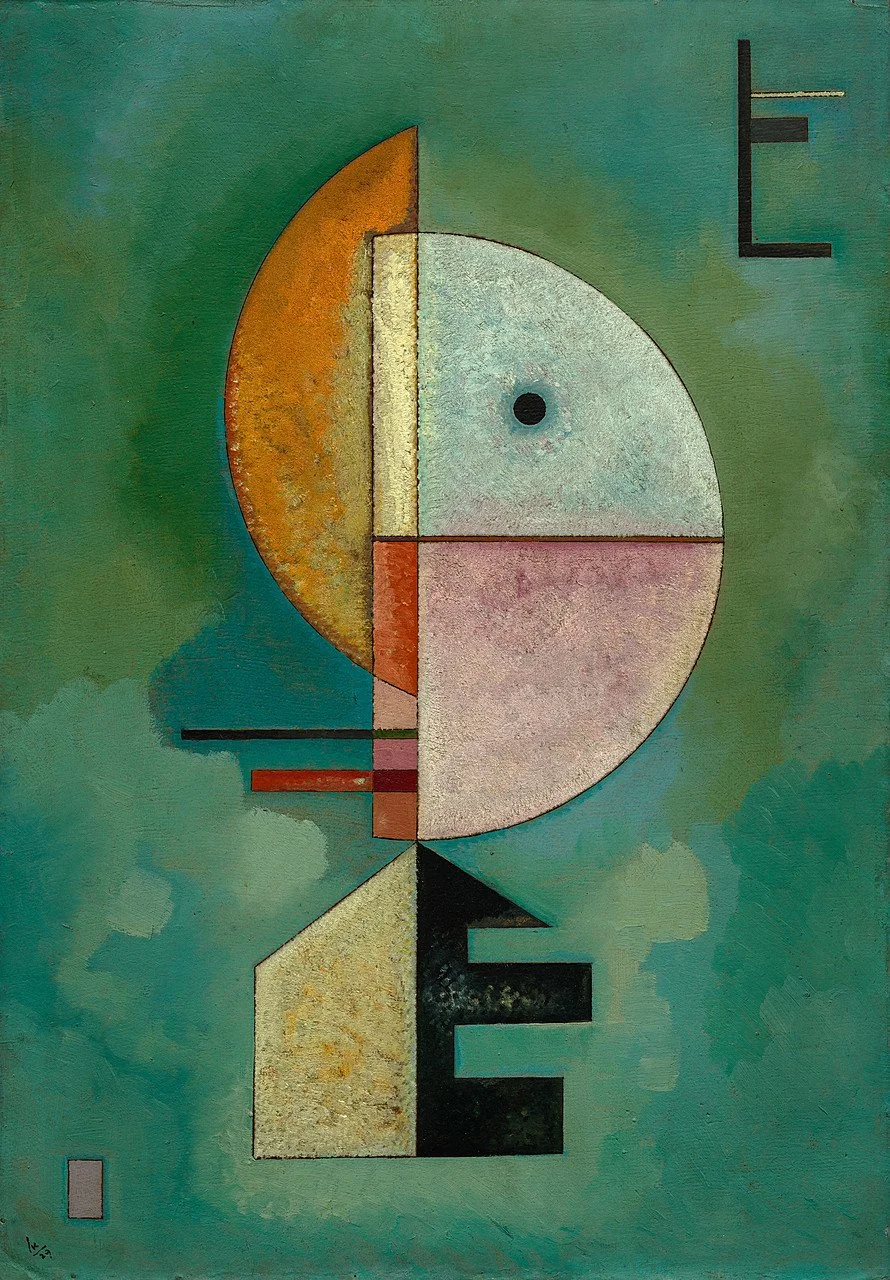
Vasily Kandinsky, Upward (1929)